


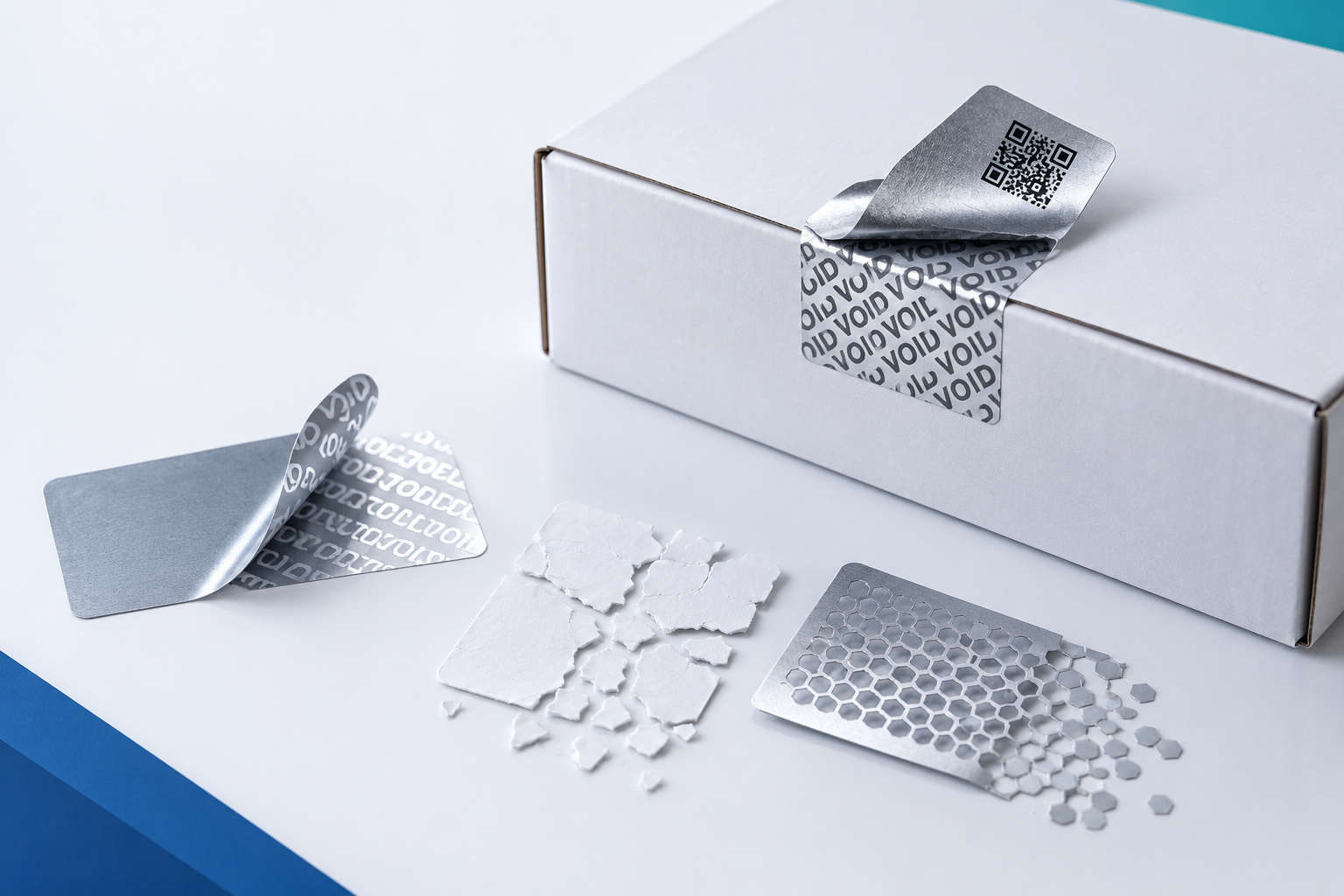
A sealed pack is a promise: nobody has opened this since it left our hands. A tamper-evident label is how that promise becomes visible. It can’t stop someone from trying to open a pack, but it makes sure the attempt shows.
This guide explains what these labels are, how the main mechanisms work, which industries depend on them, and how to choose the right one.
1. What is a tamper-evident label?
A tamper-evident label is an adhesive label engineered to show visible, hard-to-hide evidence if it is removed, lifted, cut or repositioned. It is usually applied across a seam, such as a carton flap, a bottle cap, a lid, a device port or a bag opening, so that opening the pack means disturbing the label.
Two terms are often confused:
- Tamper-evident means the damage is visible. You can tell something happened.
- Tamper-resistant means the pack is physically harder to open. It may be a stronger closure, but it doesn’t necessarily show tampering.
Labels are tamper-evident. Their value is proof, not protection. That proof matters to the consumer who opens the box, the retailer who receives it, and the brand that may have to answer for what happened in between.
2. How the main tamper-evidence mechanisms work
Void patterns
Void labels are the most widely recognized type. The label is built in layers: a face film, a release coating applied in a pattern, and an adhesive. When someone peels the label off, part of the film and its message (typically “VOID”, “OPENED” or a brand pattern) stays behind on the surface while the rest comes away with the label.
- What you see: repeated “VOID” text or a pattern on the pack and on the removed label. A label that has been peeled and re-stuck shows it.
- Why it works: the pattern is built into the construction of the label, so it can’t be switched off after printing.
- Good for: cartons, boxes, device casings, shipping seals, warranty seals and any smooth, non-porous surface.
- Watch out for: some void labels leave no residue on certain surfaces (very rough, oily or low-energy plastics), so test on your actual substrate.
Destructible vinyl
Destructible vinyl labels use a brittle film and a strong adhesive. When someone tries to peel the label, the film doesn’t stretch or lift cleanly. It shatters into small fragments that stay stuck to the surface.
- What you see: a label that breaks into pieces the moment it is disturbed, making it essentially impossible to remove whole and reapply.
- Why it works: the adhesive bond is stronger than the internal strength of the film, so the film fails first.
- Good for: asset tags, electronics, warranty stickers, equipment seals, tamper-proofing screws and panels, and any item where transfer of the label to another product is the threat.
- Watch out for: its brittleness suits flat or gently curved surfaces better than tight curves, and it is less forgiving to apply, so correct technique matters.
Honeycomb cuts
Honeycomb labels use a hexagonal pattern of fine die-cuts (or a honeycomb-patterned layer) through the construction. When the label is pulled, the pattern forces it to split into small, irregular cells instead of coming away as one piece. Some versions also reveal a honeycomb-shaped residue on the surface.
- What you see: a label that tears into a mosaic of small sections, or leaves a distinctive honeycomb mark on the pack.
- Why it works: the cut pattern deliberately creates thousands of weak points, so there is no clean path for removal, and any attempt to piece the label back together shows obvious gaps and misalignment.
- Good for: closures where partial peeling is a common attack, for example pharmaceutical cartons, cosmetic caps and food packaging.
- Watch out for: the cut pattern must be matched to the adhesive and film, or the label may tear unpredictably.
Quick comparison
| Mechanism | Evidence left | Strongest against | Typical use |
|---|---|---|---|
| Void pattern | Message or pattern on the pack and the label | Peel-and-reapply | Cartons, devices, shipping |
| Destructible vinyl | Fragments of film on the surface | Label transfer or reuse | Electronics, assets, warranty seals |
| Honeycomb cuts | Mosaic tearing or honeycomb residue | Careful partial lifting | Pharma, cosmetics, food |
Extra features that strengthen a tamper-evident label
Many labels combine one of the mechanisms above with extra layers:
- Serialized codes or QR codes so each seal is unique and can be verified online
- Holograms and color-shifting inks to make copying difficult
- Perforations and slit cuts that guide tearing
- Covert features, such as UV-reactive ink, for trained inspectors
3. Which industries require tamper-evident labels?
Some sectors are required to use tamper-evident packaging by regulation, others by customer expectation or sheer risk.
- Pharmaceuticals and healthcare. Tamper-evident packaging became the norm after high-profile product tampering incidents, and regulators in many markets require it for over-the-counter medicines. Medical devices and diagnostic kits rely on it for sterility and trust.
- Food and beverage. Sealed bottles, jars, takeaway packaging and delivery bags all use tamper-evident seals to reassure consumers, especially in food delivery.
- Cosmetics and personal care. Products applied to skin and eyes carry high safety expectations, and fake or refilled products are common.
- Electronics and IT. Seals on casings, ports and screws show whether a device has been opened, which supports warranty claims and prevents hardware tampering.
- Logistics, courier and e-commerce. Seals on parcels, containers and cash bags prove a shipment wasn’t opened in transit.
- Banking and cash handling. Cash bags, ATM components and document pouches need seals that stand up to disputes.
- Automotive and industrial parts. Genuine spare parts are heavily counterfeited, and tamper seals help prove origin.
- Government, elections and legal evidence. Ballot boxes, sample containers and evidence bags need a clear chain of custody.
- Laboratories and testing. Sample integrity affects results, so seals are used on specimens and chemical containers.
4. How to choose the right tamper-evident label
- Identify the threat. Is the risk someone opening the pack, moving the label, or copying it? The threat decides the mechanism.
- Test on the real surface. Smooth carton, textured plastic, glass, metal and curved bottle each behave differently. Always trial the label on your production material.
- Consider the environment. Cold chain, heat, moisture, oils and sunlight all affect adhesives and films.
- Decide the evidence you need. A message on the pack, fragments, or a pattern? Pick what your staff and customers will recognize quickly.
- Add traceability. A unique serial or QR code turns a physical seal into a verifiable record. See our guide to QR code packaging for how to do this.
- Plan the application process. Even the best label fails if it is applied badly, on a dirty surface or at the wrong temperature.
5. Why the source of your labels matters
Imagine a bakery that mills its own flour. If a loaf comes out wrong, they know exactly where to look, because the wheat, the grinding and the baking all happen under one roof. A bakery that buys flour from three suppliers has to guess.
Tamper-evident labels work the same way. A label is the sum of several decisions: film, adhesive, release coating, die-cut pattern, printing, serialization and finishing. When those steps are spread across different suppliers, the gaps between them are where problems creep in: an adhesive that doesn’t match the film, a batch that differs slightly from the last, a serialized run that passes through too many hands.
A vertically integrated manufacturer, one that controls these stages in-house, closes those gaps:
- Security integrity. Fewer hands touch the process, so there are fewer opportunities for materials, artwork or serial data to leak. Security features are designed with the substrate, not bolted on afterwards.
- Supply chain consistency. The same film, adhesive and process produce the same result on batch fifty as on batch one, so your label behaves the same way on your line every time.
- Faster problem-solving. If a seal underperforms, there is one team to answer to, not a chain of suppliers pointing at each other.
Specialized security-printing manufacturers such as ASY Pakistan build security labels, anti-counterfeit packaging and verification systems with this kind of end-to-end thinking, so the seal, the print and the digital check work as one system.
Frequently asked questions
What is the difference between tamper-evident and tamper-proof?
Tamper-evident labels show that someone tried to open or remove them. “Tamper-proof” suggests tampering is impossible, which no label can guarantee. The goal is visible evidence.
Can a tamper-evident label be reused?
A properly built one shouldn’t be. Void labels leave residue, destructible vinyl fragments, and honeycomb labels tear into cells, so reapplying them shows obvious damage.
Do tamper-evident labels work on all surfaces?
No. Surface energy, texture, curvature and temperature all affect performance, so always trial the label on your actual packaging.
Can I add a QR code to a tamper-evident label?
Yes, and it is a good idea. A unique QR code lets customers and inspectors verify the seal digitally as well as visually.
Final thoughts
A tamper-evident label is a small component carrying a big responsibility. Match the mechanism to the threat, test it on your real packaging, and choose a supplier whose process you can trust from raw material to finished roll. Do that, and the label turns a sealed pack into something a customer can believe.
Seal your products with confidence
Talk to ASY Pakistan about tamper-evident security labels, anti-counterfeit packaging and verification systems for your brand. Samples available on request.
Contact us WhatsApp