


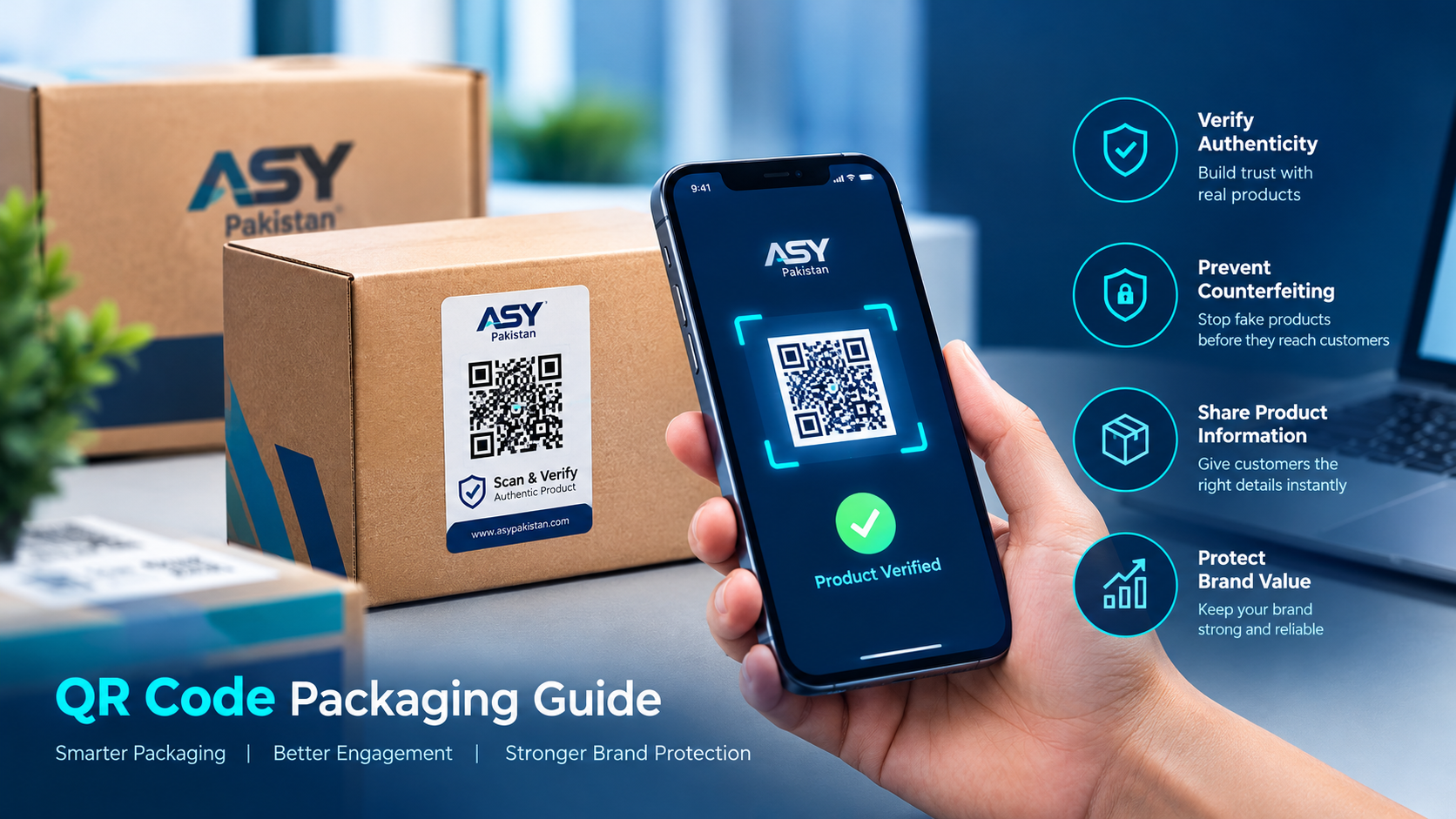
A QR code on a pack used to be a marketing afterthought, a small square pointing to a homepage. Today it can be the link between your physical product and your digital brand: a way to authenticate goods, track them through the supply chain, and keep talking to consumers after the sale.
Getting there takes more than generating a code and sending it to print. This guide covers the four areas brand managers most often get wrong or underinvest in: design, serialization, consumer experience and counterfeit protection.
1. Design best practices: make it scan every time
A QR code that fails to scan is worse than no code, because it frustrates the customer and signals poor quality. Most failures come from a handful of avoidable mistakes.
Size and quiet zone
- Keep the printed code at least 2 × 2 cm for hand-held scanning, and larger for items scanned from a distance, such as shelf or carton labels.
- Preserve the quiet zone, the blank margin around the code, at a minimum of four modules wide. Artwork, borders or fold lines intruding into it are a leading cause of failed scans.
Contrast and color
- Dark code on a light background is the safest option. Inverted (light on dark) codes are not read reliably by all scanners.
- Brand colors are fine if the contrast stays high. Avoid red on dark backgrounds and low-contrast pastels.
Error correction and logo placement
- Match error correction to the environment. Level M or Q suits most retail packs. Level H tolerates more damage, which helps with logo overlays or rough handling, but makes the code denser.
- Keep any center logo small, covering well under a third of the code area.
Surface and placement
- Avoid curves, seams, creases and heavy embossing. A code wrapped around a tight bottle radius or split across a fold will distort.
- Avoid high-gloss finishes directly over the code, because glare defeats phone cameras.
- Place the code where a consumer would naturally look, and add a short call to action such as “Scan to verify authenticity” so people know why they should scan.
2. Serialization strategies: one code, one unit
The biggest strategic choice is whether your QR codes are static or serialized.
- Static codes carry the same URL on every pack. They work for campaigns and general content, but they identify nothing about the individual unit, so they can’t verify a single item.
- Serialized codes give every unit, or every batch, a unique identifier. This is the foundation for authentication, recall management, warranty activation and supply chain visibility.
Choosing your serialization level
| Level | What it identifies | Best for |
|---|---|---|
| Batch / lot | A production run | Recalls and basic traceability at lower cost |
| Unit | Each individual pack | Single-use verification, scan-count alerts, per-item warranty |
| Aggregation | Unit codes linked to cartons, cases and pallets | Verifying a whole shipment with one scan at the dock |
Practical principles
- Use non-sequential, non-guessable identifiers. If a counterfeiter can predict the next valid code, serialization offers no protection. Use random or cryptographically generated strings, not 1001, 1002, 1003.
- Keep the data on the server. The code should hold a short URL or token, and the product data should live in your database. This lets you update information without reprinting.
- Plan your database early. Serialization at scale means millions of records and real-time lookups. Decide who hosts it, how it integrates with your ERP or warehouse system, and how it is secured before you place a print order.
- Build in lifecycle states. Each code should move through states such as generated, printed, shipped, sold and verified, so that out-of-sequence scans flag anomalies.
- Align with standards where relevant. For regulated sectors such as pharmaceuticals and food, or for export markets, GS1-compliant identifiers and Digital Link structures ease retail and cross-border compatibility.
3. Consumer-facing experiences: give people a reason to scan
Consumers scan when the payoff is clear and immediate. A code that dumps people on a generic homepage wastes the opportunity.
High-value experiences to consider
- Instant authentication. A “Genuine product” result is the most trust-building thing a scan can show, especially in categories prone to fakes.
- Digital warranty and registration. Replace paper warranty cards with a scan-to-activate flow. It captures first-party customer data and removes the lost-card problem. See our digital warranty cards.
- Product storytelling. Sourcing, ingredients, usage instructions, care guides and video tutorials.
- Loyalty and rewards. Points, cashback or prize draws tied to unique codes. Serialization is essential here, to prevent one code being redeemed repeatedly.
- Multilingual content. In markets like Pakistan, offering English and Urdu (and other languages for export packs) improves usability considerably.
- Re-order and support. Direct links to reorder, WhatsApp support or service booking.
Experience design rules
- Mobile-first, fast and low-bandwidth friendly. If a page takes more than a few seconds to load, many users will abandon it.
- No app download required. Browser-based experiences have far higher completion rates.
- Respect privacy. Be transparent about what data you collect, and collect only what you need.
- Measure everything. Scan counts, geography, time of day, repeat scans and drop-off points feed straight back into marketing and supply chain decisions.
4. Anti-counterfeiting applications: where QR codes earn their keep
Counterfeiting reaches well beyond luxury goods. Medicines, cosmetics, lubricants, electronics, spare parts, garments and even certificates are widely copied. QR codes help, but only when used properly.
Layer 1: unique, server-validated codes
Each code can be verified only once or a limited number of times. If a code is scanned thousands of times or from implausible locations, the system flags probable cloning.
Layer 2: scan intelligence
Monitor scan patterns for geographic anomalies, duplicate scans and unusual spikes. These patterns often reveal counterfeit activity before it shows up in sales data.
Layer 3: physical security features
Pair the digital code with features that are hard to replicate:
- Tamper-evident and void-on-removal materials
- Scratch-off panels that hide a secondary PIN
- Holographic and optically variable elements
- Microtext, guilloche patterns and special inks (UV, thermochromic, color-shifting)
- Covert marks that can be inspected by authorized personnel
Layer 4: consumer education
Authentication only works if people actually check. Tell customers on-pack and in advertising that scanning is how they confirm a genuine product, and make the result unmistakable.
Layer 5: enforcement integration
Feed scan data into your enforcement workflow so that suspicious clusters can lead to investigations, marketplace takedowns, and cooperation with customs and regulators.
5. Don’t overlook the substrate: where the code is printed matters
This is the point many brand teams discover too late. A QR code is only as trustworthy as the material it is printed on.
Standard commercial printing on ordinary paper, board or generic labels will usually reproduce a QR code adequately. But the same flexibility that makes it cheap also makes it easy to duplicate, peel, swap or re-apply. A counterfeiter can lift a label, photocopy it, or reprint a convincing lookalike using the same type of print.
QR codes perform best, for both scan reliability and security, when they are printed on security-grade packaging substrates and labels: materials engineered for tamper evidence, resistance to cloning and consistent print quality. In practice, that often means:
- Destructible or tamper-evident label stocks that fragment on removal, so a genuine code cannot be moved onto a fake pack.
- Substrates with integrated security features that are difficult to source or replicate outside the supply chain.
- Controlled-quality print surfaces that give crisp, high-contrast modules even in demanding conditions, which improves scan success.
- Variable data printing combined with security printing, so unique serial codes and physical protections are applied together in a single controlled process.
Brands in high-risk categories increasingly work with specialized security-printing manufacturers for this reason. ASY Pakistan, for example, focuses on security labels, anti-counterfeit packaging and digital authentication products, so the physical and digital layers are designed together. The result is more dependable than combining a generic print job with a separate software tool after the fact.
6. A step-by-step implementation roadmap
- Define the objective. Is the priority authentication, traceability, consumer engagement, warranty, or all of these? Your answer shapes everything else.
- Assess the risk. Map where counterfeiting or diversion is most likely, by product, region and channel.
- Choose the serialization model. Batch, unit or aggregated, with random, non-guessable identifiers.
- Select the substrate and security features. Match material and protections to the risk level, and consult a specialist manufacturer early.
- Design for scannability. Size, contrast, quiet zone, placement and real-world testing.
- Build the backend and experience. Verification logic, anomaly detection, a fast mobile landing page and multilingual content.
- Pilot before scaling. Start with one SKU or region, check scan success rates and consumer response, then refine.
- Educate the market. Train distributors, retailers and consumers to scan.
- Monitor and act. Review scan analytics regularly and connect them to enforcement.
- Iterate. Counterfeiters adapt, so your system should too.
7. Common pitfalls to avoid
- Printing static, identical codes and calling it “authentication”.
- Using sequential or predictable serial numbers.
- Skipping real-world scan testing on the final material.
- Sending consumers to a slow, non-mobile-friendly page.
- Treating the code as a standalone security measure.
- Ignoring the data your scans generate.
Frequently asked questions
What size should a QR code be on product packaging?
For hand-held scanning, keep the printed code at least 2 × 2 cm, and make it larger for cartons or shelf labels scanned from a distance. Always keep a blank quiet zone of at least four modules around the code.
What is the difference between static and serialized QR codes?
A static QR code carries the same link on every pack and cannot identify an individual unit. A serialized QR code carries a unique, non-guessable identifier for each unit or batch, which enables authentication, traceability, warranty activation and recall management.
Can a QR code stop counterfeiting on its own?
No. A standard QR code is easy to copy. It becomes an effective anti-counterfeiting tool when combined with unique server-validated codes, scan monitoring, physical security features and tamper-evident materials.
Why does the printing substrate matter for QR codes?
Standard commercial print can be photocopied, peeled and re-applied. Security-grade substrates and labels add tamper evidence and clone resistance, and provide consistent print quality that improves scan reliability.
Final thoughts
QR code packaging works best as a system: a well-designed code, a smart serialization strategy, an experience worth scanning, and a physical foundation that resists tampering. Brands that treat it as a one-off print job get a marginal marketing benefit. Brands that treat it as infrastructure gain a protected supply chain, a direct line to consumers and measurable brand equity.
Protect your products with secure, scannable packaging
Talk to ASY Pakistan about anti-counterfeit labels, security packaging and verification systems for your brand. Samples available on request.
Contact us WhatsApp