


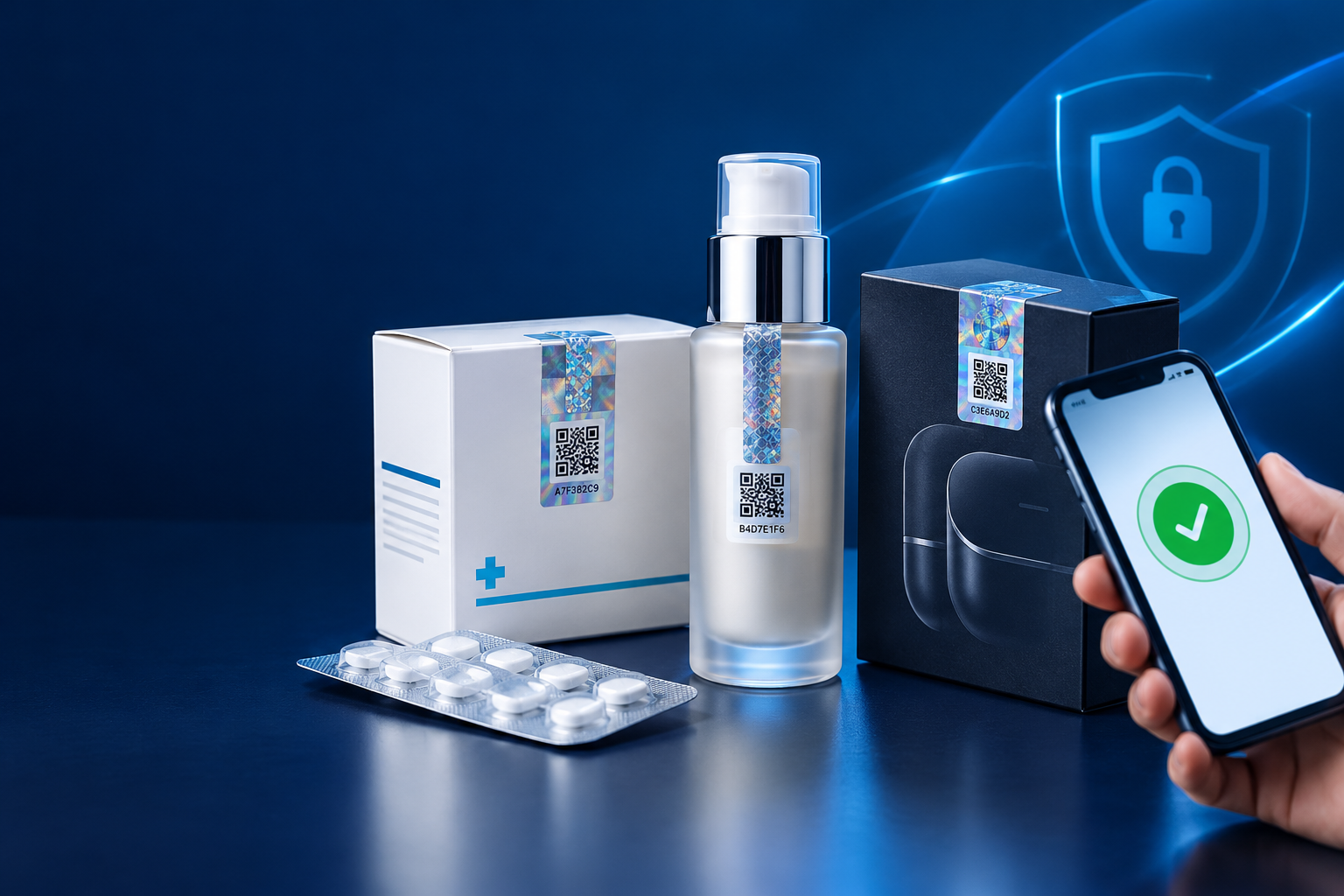
Counterfeiting is no longer limited to luxury handbags. Fake medicines, cosmetics, engine oil, electronics, garments, spare parts and even certificates now circulate in markets worldwide, including Pakistan. Counterfeits cost brands revenue and reputation, and they can seriously harm consumers when the product is something people swallow, apply to their skin or rely on for safety.
The good news is that detection has improved. No single check is foolproof, but combining a few simple methods catches most fakes. This guide covers the four most practical approaches, from what any consumer can do in thirty seconds to what brands can build into their packaging.
1. Visual inspection: your first line of defense
Visual checks need no equipment, and they catch a surprising number of fakes because counterfeiters usually cut costs on printing and materials.
- Print quality. Genuine packaging has sharp text, consistent colors and clean edges. Blurry logos, smudged ink, misaligned colors or pixelated images are warning signs.
- Spelling and wording. Typos, odd grammar, wrong addresses and missing regulatory information (batch number, manufacturing and expiry dates, registration numbers) are common in fakes.
- Materials and finish. Compare the box, bottle, cap and seal against a product you know is genuine. Differences in weight, paper stock, plastic texture or the sound of a cap closing can be telling.
- Seals and closures. Check that tamper-evident seals are intact, evenly applied and not re-glued. Shrink sleeves should fit cleanly.
- Batch codes. Printed or laser-etched batch codes should be crisp, consistent in font, and match between the outer carton and the product itself.
- Price and source. A price far below market rate, or an unauthorized seller, is itself a red flag.
2. Security features you can see and feel
Brands increasingly add features that are deliberately hard to reproduce. Knowing them helps you check authenticity quickly.
- Holograms. A genuine hologram shows depth, movement and changing images as you tilt it. Flat, dull or static “holographic-look” foil is a common fake.
- Color-shifting ink. Colors change (for example, green to blue) when the label is tilted. Standard printing can’t do this.
- Microtext. Tiny text, readable only under magnification, appears as a solid line to the naked eye. Copiers usually turn it into a blur.
- Tamper-evident materials. Labels that leave a “VOID” pattern or fragment when peeled show that the label was removed.
- Guilloche patterns. Fine, intricate line patterns, like those on banknotes and certificates, are extremely difficult to copy accurately.
3. UV light testing
Many security inks are invisible in normal light but glow under ultraviolet (UV) light. This is one of the most widely used covert authentication methods, and it is fast.
How to do it
- Use a UV torch. A 365 nm wavelength gives the clearest results for most security inks, though some features respond to 395 nm. A cheap keychain light may be too weak or may emit the wrong wavelength.
- Dim the room if possible, and hold the light a few centimetres from the surface.
- Look for the expected feature: hidden logos, patterns, serial numbers or fibres that fluoresce in a specific color.
What to check
- The hidden mark appears in the right place and color.
- The surrounding paper or label doesn’t glow brightly. Many ordinary papers contain optical brighteners that glow blue-white, whereas genuine security paper is often brightener-free.
- The fluorescence is crisp and consistent, not blotchy or hand-applied.
Where it’s used: banknotes, certificates, ID documents, pharmaceutical packaging, branded labels and security papers.
4. QR code scanning
QR codes make verification accessible to anyone with a smartphone, but how they are implemented matters a great deal.
A basic QR code is not security. A static QR code simply points to a webpage. Anyone can print the same code on a fake product, and it will lead to the same “genuine” page.
A secure QR code carries a unique, non-guessable identifier. When scanned, it is checked against the brand’s database, which can respond with:
- Genuine or not genuine status
- Product details (name, batch, manufacturing and expiry dates)
- A warning if the code has been scanned an unusual number of times, which can indicate duplication
Tips for consumers
- Scan with your phone’s camera and check the web address before entering any information. Fake QR codes can lead to phishing sites.
- Treat a “genuine” result with caution if the website looks unprofessional or the address doesn’t belong to the brand.
- Report suspicious scan results to the brand.
5. Serialized label verification
Serialization is the most robust of these methods because it gives every individual unit its own identity.
How it works
- Each label or pack is printed with a unique serial number, a random code that can’t be predicted, often paired with a QR code, scratch-off PIN or barcode.
- The code is stored in a secure database linked to the product, batch and manufacturing details.
- When a customer, retailer or inspector checks the code (via SMS, website, app or scan), the system confirms whether it exists, whether it matches the product, and whether it has already been verified.
Why it’s powerful
- Duplicate detection. If the same serial is verified in two different cities within minutes, one of them is a copy.
- First-scan logic. Scratch-off or one-time codes show a warning if the code was already used.
- Track and trace. Brands can follow products through the supply chain, spot diversion and gray-market leakage, and recall specific batches.
- Data for brands. Scan locations and counts reveal where fakes appear.
6. Why layering beats any single feature
Each method above has a weakness. Visual checks can be fooled by good printing, holograms can be imitated, static QR codes can be copied, and UV inks can be mimicked at a basic level. But a counterfeiter who must reproduce all of these at once, convincingly and at low cost, finds the economics collapse. This is why serious brand protection uses layered security:
| Layer | Who checks it | Examples |
|---|---|---|
| Overt | Anyone, instantly | Holograms, color-shifting ink, tamper-evident seals |
| Covert | Trained staff or with simple tools | UV-reactive ink, microtext, hidden patterns |
| Digital / forensic | Verified via database or lab | Unique serial codes, secure QR, track-and-trace data |
Security-printing manufacturers such as ASY Pakistan build security labels, anti-counterfeit packaging, certificates and digital warranty cards around exactly this idea. Because several features sit on a single label, a retailer can run a visual check in seconds, an inspector can confirm with UV light, and a customer can finish the job by scanning a code. The brand gets cross-checked evidence rather than a single point of failure, and the buyer gets a faster, more confident answer.
7. Checklists
For consumers
- Buy from authorized sellers.
- Compare the packaging with the brand’s official images.
- Check the seal, print quality and batch details.
- Tilt the label to test the hologram or color-shifting ink.
- Scan the QR code or enter the serial number on the brand’s official verification page.
- When in doubt, don’t use it, and report it to the brand or the relevant regulator.
For brands
- Use at least three layers of protection (overt, covert, digital).
- Make every unit uniquely serialized, not just every batch.
- Build a fast verification page that works on low-bandwidth phones, in English and Urdu.
- Educate consumers and retailers by printing “how to verify” instructions on the pack.
- Monitor scan data for duplicates and unusual patterns.
- Refresh security features periodically so counterfeiters can’t keep up.
- Work with an experienced security-print partner so labels, packaging and verification are designed together.
Frequently asked questions
How can I tell if a product is counterfeit?
Buy from authorized sellers, compare the packaging with the brand’s official images, check print quality, seals and batch details, test any hologram or color-shifting ink, and verify the QR code or serial number on the brand’s official verification page.
Is a QR code on a product proof that it is genuine?
No. A static QR code can be copied onto a fake. A secure QR code carries a unique identifier that is checked against the brand’s database, which can flag unknown or repeatedly scanned codes.
What UV wavelength is used to check security inks?
365 nm gives the clearest results for most security inks, though some features respond to 395 nm. Always compare against the brand’s reference image of the genuine feature.
What is serialized label verification?
Each label or pack carries a unique, non-predictable code stored in a secure database. When the code is checked, the system confirms whether it exists, matches the product and has already been verified.
Final thoughts
Counterfeit detection is no longer about expertise alone. With layered labels and simple digital verification, any buyer can confirm authenticity in under a minute. For brands, the investment protects revenue, reputation and, in many industries, customers’ health.
Protect your products with layered security
Talk to ASY Pakistan about anti-counterfeit labels, security packaging and verification systems for your brand. Samples available on request.
Contact us WhatsApp